
BBA 2025 Winner Profile: Digital, Tech & Innovation – Quantinuum
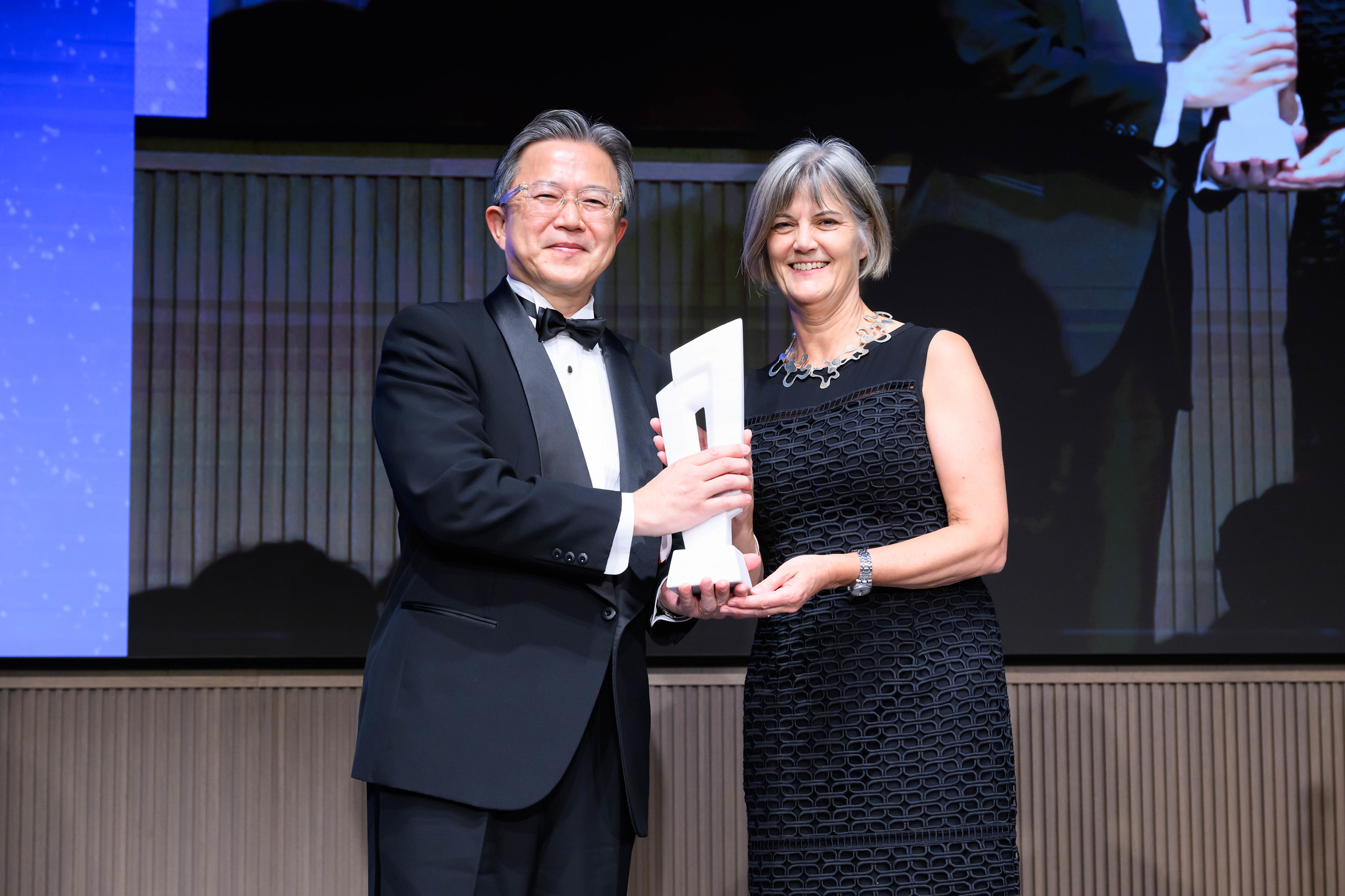
Quantinuum, a global leader in quantum computing, has been commended for 'exceptionally effective digital and technological innovation in Japan within the past 12 months' at the British Chamber of Commerce in Japan’s annual gala in early November.
The UK- and US-headquartered company was awarded the 2025 Digital, Tech & Innovation British Business Award in recognition of its ion-trap computer Reimei, which was installed in 2025 at RIKEN, Japan’s largest and most comprehensive national research institute for natural sciences, and integrated with Fugaku, Japan’s national flagship supercomputer. The initiative has created the world’s first hybrid platform of high-performance computing and quantum computing, designed to power humanity’s next breakthroughs.
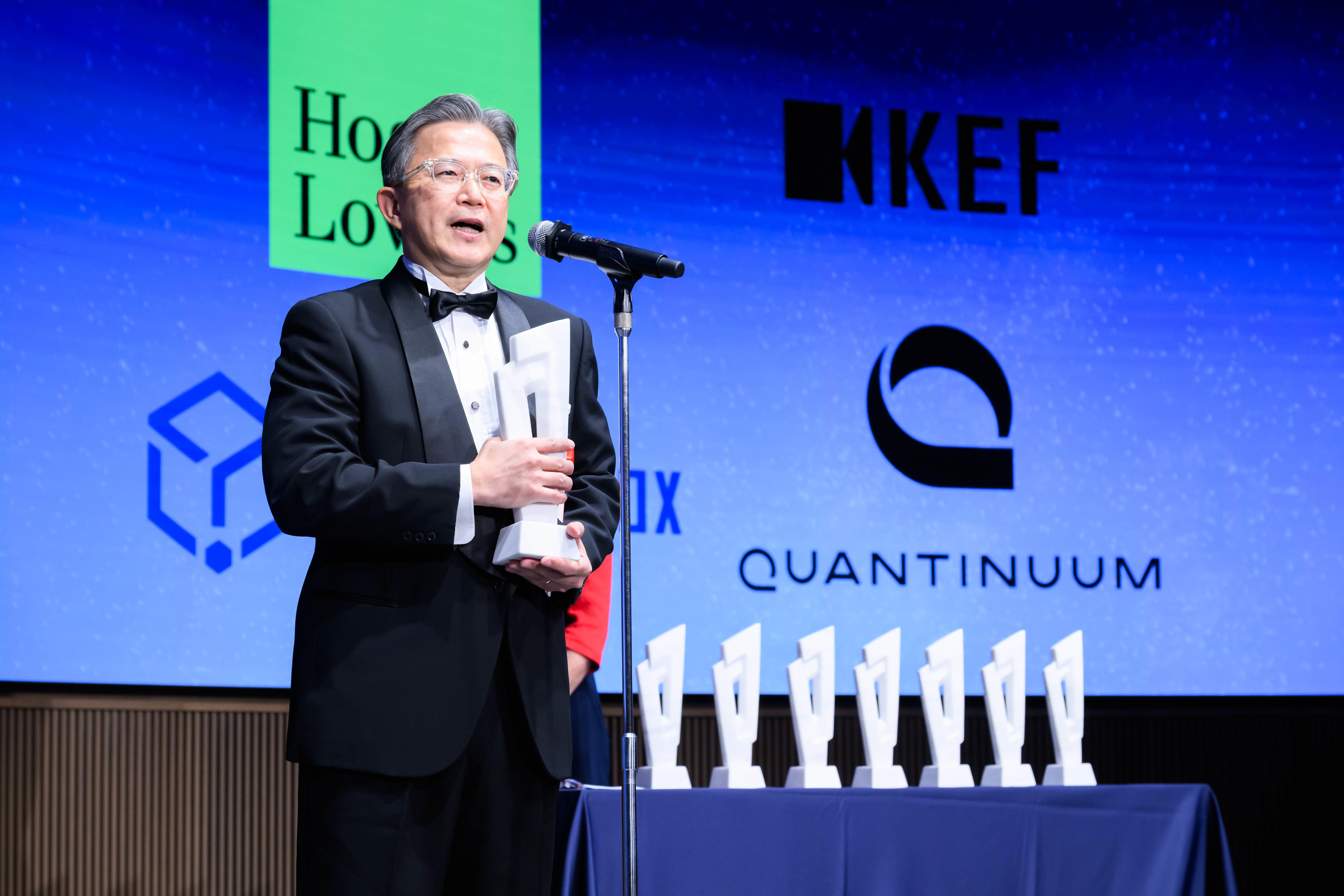
Representatives from Quantinuum in Japan accepted the bespoke trophy by Kate Thomson of Ukishima Sculpture Studio at the BCCJ’s black-tie event and sent live updates to their colleagues in the UK so everyone could be part of the celebration. The award is now on display in the Japan office as 'a testament to the strong relationships the company has cultivated between the UK and Japan, as well as other countries,' said Shuya Kekke, CEO and representative director of Quantinuum in Japan.

Launching Reimei
As a full-stack quantum computing R&D centre, Quantinuum aims to drive quantum science forward. Through its world-class research programme, featuring experts specialising in quantum hardware, software and communication, its goal is to create commercial products and develop the future generation of quantum innovators.
While commercial operation of quantum computing has been underway for only about five years, Kekke sees rapid acceleration in the field, aided by the investment and R&D of companies. At this pace, quantum technology could reach a tipping point within a decade and have dramatic applications for commerce and industry, much like the way ChatGPT left the laboratory in November 2022 and has since transformed business.
Since its establishment in 2019, Quantinuum has sought to collaborate on the world’s first programme combining high-performance computing and quantum computing. This goal was realised in February with the integration of Reimei, its 20-quibit computer, with Fugaku at RIKEN.
'We’ve created a hybrid infrastructure where traditional and quantum ways of computing are managed as one computer,' said Kekke. 'Now we’re experimenting and developing software to figure out the best way to use these radically different technologies to advance the frontier of what can be done on a computer.'
Running from November 2023 to October 2028, the project is funded by Japan’s Ministry of Economy, Trade and Industry through its funding arm, the New Energy and Industrial Technology and Development Organization. It involves Quantinuum collaborating with RIKEN, the University of Tokyo, Osaka University and Softbank to carry out tasks ranging from writing middleware (the software that acts as a bridge between different applications, systems and services) to creating a strategy for commercialisation of academic findings.
Researchers are using a scientific process to choose the five or six areas of focus for the project based on where the quantum-supercomputer hybrid platform might have the biggest impact. Options include pharma, whereby thousands of simulations of drug formulas could be carried out on the computer, dramatically reducing the need for wet lab experiments. Other possibilities lie in manufacturing, such as in modelling of aircraft parts, and finance, which would involve leveraging the computer for data analysis and fraud detection.
'We hope we will be able to better understand the type of areas where quantum computers can be first integrated. Eventually we hope to make an impact across industries, but with new technology like this, it’s important to have early wins,' explained Kekke.
Fostering partnerships, growth
In Japan, Quantinuum is 'taking a partnership-based approach to achieve a stronger foundation and a larger industrial reach,' added Kekke. Its three strategic partners—RIKEN, Mitsui & Co. and Softbank—are involved in product development based on what their customers need, both now and in the future.
The company is collaborating with general trading conglomerate Mitsui & Co. on applications for computational chemistry, AI and cybersecurity. This year, the pair completed the first trial to advance unforgeable quantum tokens over a fibre network, marking a significant step toward quantum-enhanced financial security and commercial quantum key distribution. Furthermore, Mitsui & Co. launched QIDO, a new software platform based on Quantinuum’s scientific engine.
With telecom operator Softbank, joint efforts are focused on research related to the development of data centres and infrastructure for the commercialisation phase of quantum computers.
To facilitate all this work, Quantinuum is expanding to add highly skilled staff across its eight international offices. As of December 2025, it employs more than 650 employees worldwide who together hold more than 420 PhDs and Masters degrees, making Quantinuum home to the largest concentration of quantum experts outside of academia.
In Japan, locally hired, Japan-educated researchers are among those with major responsibilities in driving the company’s collaborative research work, reducing reliance on flying in team members from other countries, according to Kekke.
Other notable achievements
In March, Quantinuum was selected as a founding collaborator for the NVIDIA Accelerated Quantum Research Center, a strategic hub for quantum innovation located in Massachusetts, USA. The tie-up will involve use of Quantinuum’s second-generation quantum computer, the 56-qubit H2 System, to train AI systems, which is expected to enable AI models to tackle challenges previously deemed unsolvable.
The development of this H2 System is significant because traditional supercomputers are not able to replicate the actions of a quantum computer powered by more than 50 qubits. Quantinuum’s H2 System, therefore, was the most powerful computer in the world at the time.
Last month, Quantinuum went even further, launching its third-generation quantum computer, Helios. Following the signing of a strategic alliance with Singapore’s National Quantum Office, this 98-qubit computer will be shipped to Singapore to provide direct, on-site access for researchers who are bridging the gap between quantum research and real-world problems.
Other highlights in 2025 include the company’s successful completion of a fundraising round, which generated US$ 600 million from investors such as JPMorganChase, Cambridge Quantum Holdings, Mitsui, NVentures (NVIDIA’s venture capital arm) and Honeywell.
Expanding networks
Supported by its strategic partners, Quantinuum aims to create a global community to share its progress in quantum computing and make it easier for other companies to more easily access information about the field. In Japan, team members provide learning opportunities through workshops and lectures for universities and businesses.
Kekke hopes that by developing relationships with the BCCJ and its members, the company can expand its network and reach more people with these informative sessions, either in person or online. By providing firsthand, up-to-date details about quantum computing to a greater number of researchers and business development professionals in quantum and related fields, Quantinuum aims to support the long-term development of the industry.